Analysis of the Geography and Economic Reasons Explaining the Failure of H.S.R. in America

Ben Lowenthal
Honors Project: Analysis of the Geography and Economic Reasons Explaining the Failure of H.S.R. in America
Honors Course: Honors Composition I
Instructor: Olabisi Adenekan
My name is Ben Lowenthal, and I’m a first-year student studying Engineering. Through the Grainger Engineering Pathways Program, I plan on transferring to the University of Illinois to pursue a degree in Aerospace Engineering. Oakton’s Honors Program has been an outstanding opportunity for hands-on, practical learning. Through the projects and contracts, I have been able to refine, test, and learn knowledge and skills that will apply to my future academic and career pursuits. The beauty of the Honors Program is that while building relevant skills for future pursuits, I can simultaneously learn about subjects in my interests. This makes each course more enjoyable and fulfilling, which I am truly grateful for.
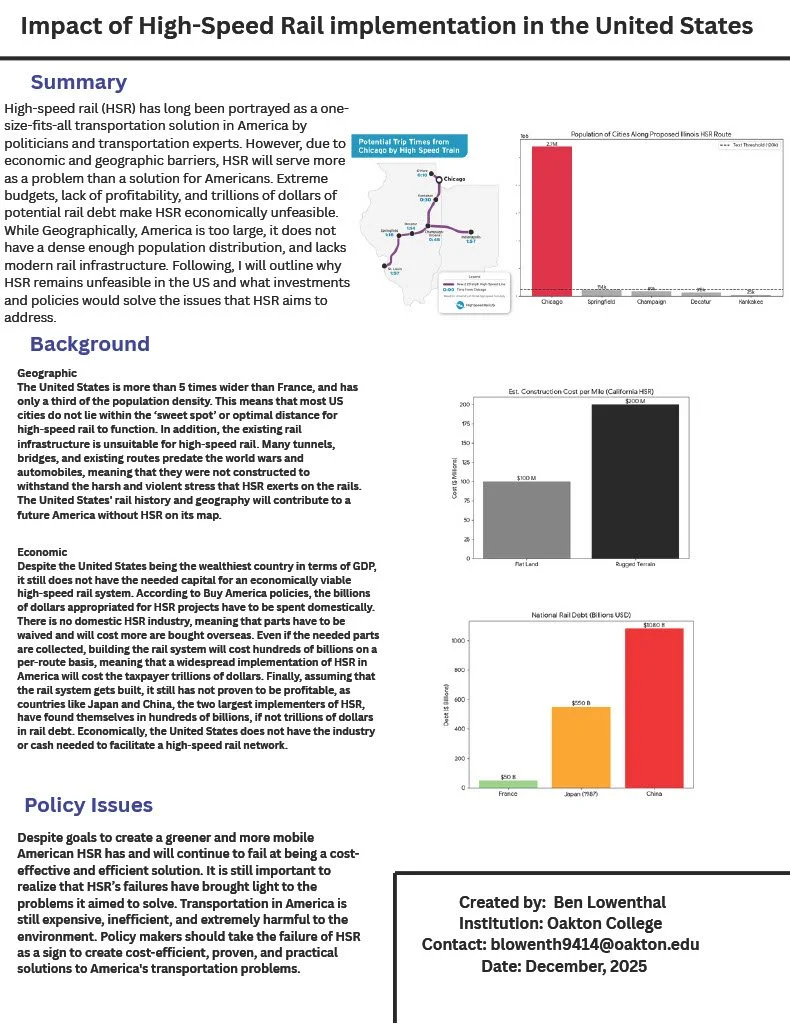
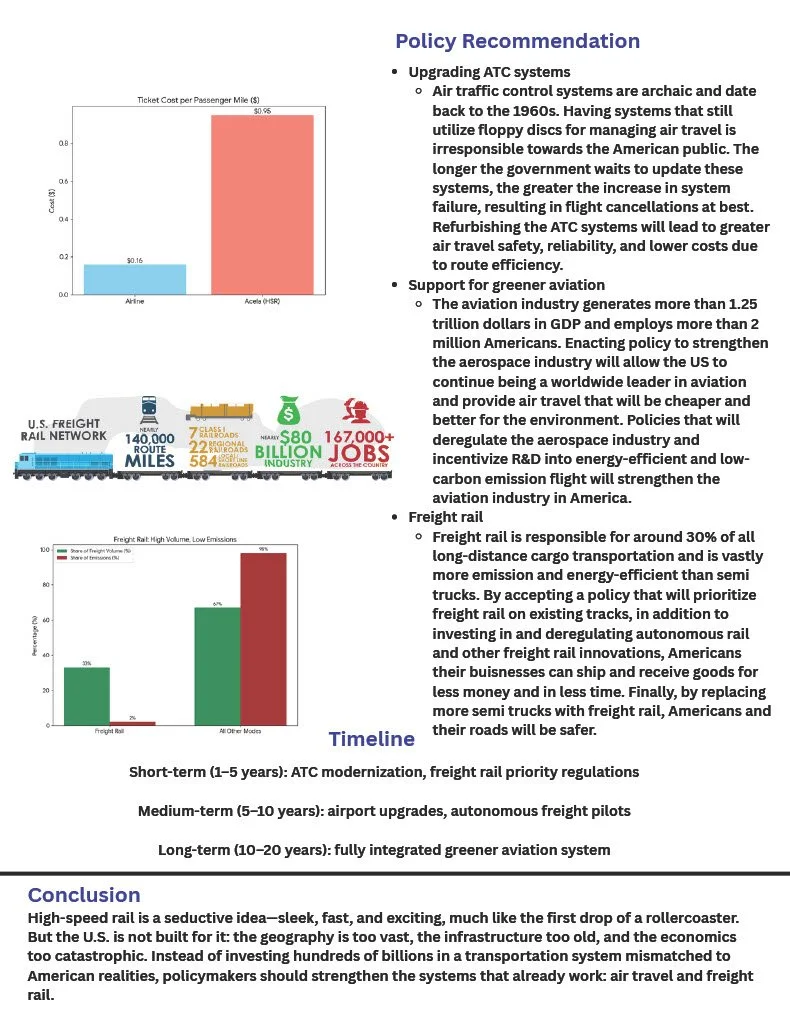
This project examines the geographic and economic factors that have contributed to the persistent failure of high-speed rail (H.S.R.) in the United States. With the guidance of Dr. Adenekan, I delved into a foreign topic with an unbiased mind in search of answers to my various research questions. The topic of H.S.R. in the U.S. was chosen out of curiosity and its relevance to the conversation of contemporary transportation solutions. Given that H.S.R. has been implemented in various nations and regions across the globe, I was intrigued as to why the United States, known for being a railroad pioneer and at the forefront of modern technology, was not one of them. In my paper and the included artifact, I discussed the difficulties of HSR in the U.S. and proposed alternative solutions to the problems H.S.R. aims to solve.